

Euphysics I
Why Traditional Ethics Fail in a Thermodynamic Universe

I’ve always wanted to be a good person. After all, my Roman Catholic upbringing—as well as many of your own—taught me that being a good person was how one became happy.
We have every reason to believe good and happy go together like puppies and rainbows. We’ve been told as much for millennia: Plato assures us that seeking virtue is the greatest good and the only means of achieving happiness. Aristotle puts more logic into Plato’s dialectic, but they agree. And when Christianity entered the picture, St. Augustine and Thomas Aquinas made sure that good and happiness remained coupled together for the many centuries that followed.
Because I’m an autist,1 my culture’s morality wasn’t something that I picked up and internalized as axiomatic.2 The Latin American culture I was born into offered me important guidelines for morality as a boy growing up in the 1990s: date several women at once, never show any emotion other than anger, being gay is worse than murder and about equivalent to child sexual abuse, and many more rinds of venomous wisdom that constitute Latin American machismo. My disconnection from mainstream morality was further moderated by the fact that I was raised by a grandiose narcissist for whom “the good” amounted to little more than “that which I want in the present moment.” Instead, I had to observe, critically analyze, and formally operationalize how I was going to choose to live my life. And I had many objections to the bullshit that the mainstream considered—and considers—“good.”
A Woman’s Search for Meaning
Lacking any nearby models for good, I searched abroad for a meaning to life and an end to suffering. In that way, I was much like Siddhartha, and I crossed paths with many religious traditions along the way. Over the years, I learned that he and I had a lot in common—William James would cheekily agree. I would deeply appreciate his smirk because the years also taught me how much we didn’t.
If Colombia (still) had castes, my family—the well-to-do founders of a Spanish settlement in Colombia’s highlands—would have definitely been Brahmin. Unlike Siddhartha, however, I was not raised royalty—the United States’ continental War on Drugs led to all our holdings being razed sometime in the early 1970s, a decade before I was born. Despite this, my mother believed, in her heart of hearts, that we remained wealthy and powerful, and as with any narcissist, reality testing failed her utterly. And that was the first difference. I was Brahmin only because my mother believed that we were.
The second difference between us arrived to me nearly at age forty, when I realized that no matter how good I tried to be, I could not be happy. It was a disappointment to learn how unhappy, in fact, being good can make you. In the 12th century, Walter Map’s character Eudo acknowledges that “no good deed goes unpunished, no bad one unrewarded.”3
Sad though it may be, no idiom lasts eight centuries without carrying with it more than just a kernel of truth. I suspect we may find a whole ear in the damn thing.
And so we return to the problem of suffering, its end beyond arm’s reach. Siddhartha discovered his solution to the problem by choosing to meditate alone and to sever himself from his earthly wants. He believed this was the only way to free himself from suffering; he wanted to be free of suffering, and so he chose to act in such a way that would acquire for him that which he wanted.
One wonders how different Buddhism would be today—or if it would exist at all—if the Buddha had not possessed the privilege to choose exactly how he would go about ending his suffering.
The Shitty Old Ways
A Critique of the Critique of Reason
Kant’s deontology was, for a long time, the basis for moral reasoning in the Western world. For many folks in the Western world, and within the context of an individual nation-state’s culture, deontology is the way they view ethics locally. Any one of us who has ever met a single person from a different culture instantly knows that Kant’s deontology fails the test of reality, but experience and logic are different domains entirely, and so we must do battle with Kant where Kant’s deontology lives: in the realm of logic.
So, let’s review. Deontology is characterized by three principles that directly impact how its ethical strictures are applied to the real world:
The Categorical Imperative: Kant argues that categorical imperatives—i.e., universal moral laws applicable to all rational beings (e.g., humans, angels, or extraterrestrial aliens)—are derived a priori from practical reason. Because they derive from reason itself, they do not depend on empirical conditions such as environment, upbringing, or experience for their validity.
Moral Absolutism: Moral duties are absolute and invariant. There are never exceptions to categorical imperatives, no matter the needs of the present moment or the reality of the world that one lives in. Absolutely no circumstance can make an unethical act acceptable.
Perfect Objectivity: To derive a universal law, Kant believes we must isolate our wills from all our external desires, which we can then test against categorical imperatives to see whether they are universally applicable to all rational beings. Fortunately, every single one of us is capable of perfect objectivity, and there is no problem with this principle at all.
/s
If you’re an autist, you have personally experienced how unhappy pursuing Kant’s deontology can make you. If you’re not, here’s an example:
You are a well-meaning, ethical, male professional in the modern workplace. A new supervisor was just hired for your team, a woman who happens to be physically fit and conventionally attractive, as well as being a phenomenal leader who seems poised to make some great changes to the team. A senior colleague of yours, also male, asks you whether you’d like to “hit that,” referring to your boss. You quietly tell your colleague that it is disrespectful for you to consider or discuss such things at work, and you ask your colleague never to talk to you about this again.
A week later, you’re called into HR. You’re told that someone has accused you of sexual harassment on account of your sexualizing your new supervisor at work, and you’re likely to be terminated for it.
What happened? A lot of my colleagues asked this too. Unfortunately, things like these happen to whistleblowers all the time,4 and as in this case, sometimes to would-be whistleblowers.
It’s the same thing that happens anytime you approach a real-world scenario the way Winnie-the-Pooh would approach his adventures in Frank Miller’s Sin City. A deontologist must assume that the rest of the world is acting in good faith—and they’d better be, or the deontologist is fucked. The same is true of the autist or of any other person that attempts to be good without accounting for the reality that cruel people exist, let alone the reality that average, non-cruel people will enthusiastically engage in cruel behaviors if the culture within which those people live creates perverse incentives for them to do so.
And if a culture can force average people—many of whom consider themselves, without a shred of cognitive dissonance, to be good people—to perform evil acts, then maybe all morality really is culturally relative. Maybe the autist, who relies on logic and reason more than on feeling or instinct, who is by her nature disconnected from the very culture into which she was born, truly is fucked.
When God Becomes Democratized
So deontology sucks because tons of people out there will fuck us and not even sweat it. Lucky for us, the rise of globalism at last gave us a critique of Western morality that would shatter the European need to break all other cultures in order to inject its own. As diverse societies were forced to interact more and more, the average European finally learned about the average Asian, the average Arab, the average African, etc. And while there remains a great deal of ignorance at which to chisel away, the average European moral agent began to see moral agents in their counterparts within other cultures, nationalities, ethnicities, and religions.
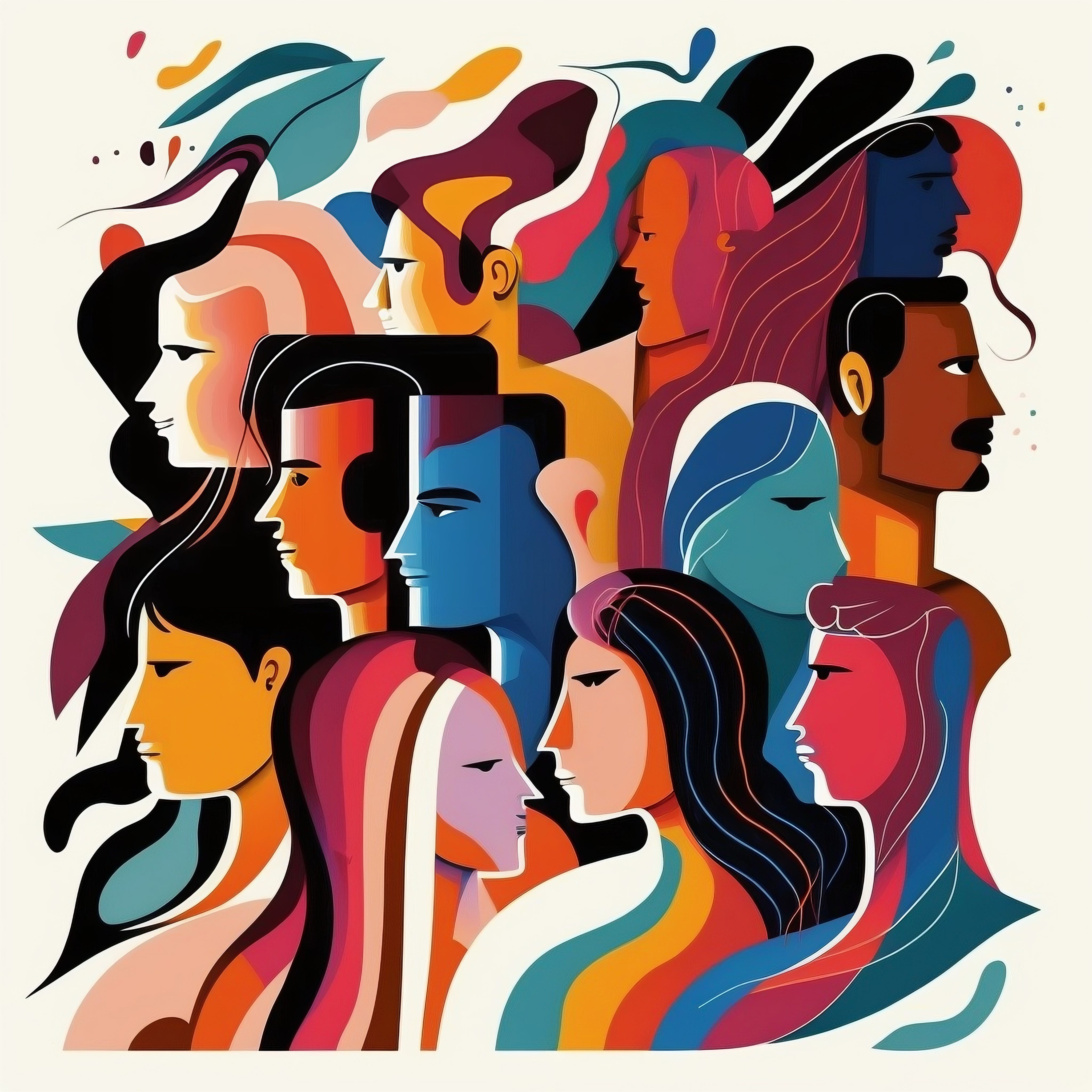
For the first time since the Persian Empire,5 we began to see the potential for widely diverse human beings to live together in harmony without the state having to actively interfere to keep the peace between peoples wholly unlike one another. In the average 21st-century suburb in the United States, a Muslim woman from a family with strong taboos against using alcohol and women showing their faces in public could have a chat through her niqab6 with her flamboyantly gay neighbor as he gets ready to leave with his friends, all dressed in drag, for a night out drinking. Both cultures’ mores are held firm and do not even have to bend particularly far to coexist alongside one another. The Muslim woman is appropriately dressed—so that no man may lay his sinful gaze upon her7—and talking with the drag queen is OK because the male neighbor is so flamboyant that the family next door considers him to be, socially, more akin to a woman,8 without ever considering his private sexual behaviors at all, let alone railing against how evil they are.
That’s pluralism at its best, and when pluralism is working well, moral relativism truly does seem to lead us toward a happier world. It allows people with different ethical systems to thrive together, insofar as either is capable of thriving alone.
And that’s the rub. Thriving alone is literally impossible in an interdependent world like ours, in a thermodynamic universe like ours. With limited resources and scarcity fueling our intercultural relations, what one culture takes, another must give up. If one culture takes too much—as many European cultures infamously have—then other cultures are left with nothing, and moral relativism requires that we respect Europe’s right to claim ownership over all of Earth and its peoples. That was certainly the argument Europe would have made when it was at the height of its imperialistic furor, and in a morally relativistic world, only the “beneficence” of the European empires suffered any culture besides its own to live.
Thriving alone becomes impossible in an interdependent world where space has not already been set aside for the next generation—and it hasn’t. I cannot thrive alone if I am one of the four million girls annually at risk of undergoing genital mutilation because my Somali family thinks it’s good that this should be done to me.9 I cannot thrive alone if I cannot keep a stable job or family life because I am Palestinian and Israel keeps bombing my workplace and home. I very obviously cannot thrive alone as a homeless person living in the United States, where the government is quicker to put spikes on park benches than offer sustainable housing options for the destitute among us.10
Deontology has failed us. Moral relativism has failed us. Suffering remains, evil triumphs unabated, and only about 7% of us identify with the religion that Siddhartha invented to save the world from suffering11 because the treatment (i.e., isolation on a mountain and gardening as both job and self-care routine) is inaccessible to the vast majority of us.
On the Want for Suffering’s End
Now that we’ve covered some of the problems with deontology and relativism, let’s circle back to Siddhartha’s journey and his conclusion that suffering is born of want. The conclusion is intuitive because it’s obvious. Of course suffering comes from want. You want something, you don’t get it, you feel shitty. We can all relate to this kindergarten-level morality. I want a toy, another child takes the toy, I cry. Want is absolutely the source of suffering for all living beings because want is the biological mechanism that our physical bodies use to tell us what it is that we need.
If suffering is want, then suffering is literally written into the very structure of the human body. If suffering is want, then the issue with ridding ourselves of it becomes clear only when we reduce want to its most basic form: the want for air:
Joan takes a corticosteroid daily to moderate her asthma symptoms. She does this daily, consistently, and enthusiastically because if she doesn’t, she could have an asthma attack. During an asthma attack, she struggles to breathe, her knees buckle and her posture wobbles, and she certainly suffers. In order to prevent her suffering, she will need regular access to her corticosteroid medication.
In the United States of America, Joan’s access to corticosteroid medication is not guaranteed; it is not considered a human right to have access to life-saving medication. If Joan fails to engage productively with the labor market in her nation-state, either via paid labor or absolute, unquestioning compliance with her state’s social welfare systems, then she will be prevented from accessing those very same corticosteroids by “health providers” (so-called), who are deputized by her state’s laws to stand between Joan and her life-saving medication.
Joan’s body does not keep her alive. Joan’s labor keeps her alive. Joan’s purchasing power keeps her alive. For Joan, relinquishing her physical wants is a death sentence.
No Buddhist meditation regimen exists that is capable of correcting a biological error that, in Siddhartha’s time, would have resulted in Joan’s painful death shortly after our premature birth.12 I wonder how one is meant to reach spiritual enlightenment when one’s body does not permit one such privileges as breath or mobility.
No Buddhist meditation exists that can heal developmental injuries, and that was never an intended goal of Buddhism to begin with. Buddhism is for abled bodies who can climb a mountain, choose the quantity of oxygen they take in with every breath, and engage in repetitive physical tasks. It is inaccessible to someone like Joan, who is only alive because she has access to money, and in our country, our moral ethos—capitalism—holds that this is good.
What’s Left?
So if we can’t rely on deontology, relativism, or asceticism, we can try doing something entirely different: building on a new foundation, rather than keep building on a foundation that’s already been broken for centuries. Millennia in some cases.
But before we build anything new, we should try to deduce a rule for shitty ethical systems from what we’ve done before. Any baby thrown out with the bathwater is a waste of good meat, and here, we waste none of the animal.
Listen, if you’re new here, I’m sorry this is how you found out where you were. Don’t worry, though; there’s enough baby for everyone.
You’re Ending It Here?
I know, it’s unusual. But I stumbled onto this topic, and now I can’t stop. I have five essays planned for this thing. Next time, we’ll get into a little logic.
I’ve now warned you ahead of time.13
In the field of social justice, we use people-first language when discussing mental illness: for example, a person with autism spectrum disorder (ASD). Identity-first language is used for neurodiverse identities: for example, an autist or an autistic person. That’s your basic rule of thumb here. If it’s a disorder, person-first; if it’s an identity, identity-first.
For more on how neurotypicals internalize their culture’s conventions as axiomatic truths, see: Turiel, E. (1983). The development of social knowledge: Morality and convention. Cambridge University Press.
Map, W. (1983). De nugis curialium: Courtiers trifles (M. R. James, Trans.; C. N. L. Brooke & R. A. B. Mynors, Eds.). Clarendon Press. (Original work composed c. 1181–1193).
Near, J. P., & Miceli, M. P. (1985). Organizational dissidence: The case of whistle-blowing. Journal of Business Ethics, 4(1), 1–16.
Specifically, I’m referring to the pluralism of the Achaemenid Empire founded by Cyrus the Great, who inherited the regional throne of Anshan in 559 BCE. Cyrus the Great led a revolt against his overlord, King Astyages, and overthrew the Median Empire, absorbing its territories into a new, consolidated Persian state in 550 BCE.
A veil that covers the face but leaves the eyes clear. The term more commonly known for this item of outerwear is the burqa, but the burqa differs in that its face covering includes a mesh screen over the eyes.
In Islam, the concept of haya (i.e., modesty/shame) emphasizes the protection of an individual’s body sanctity by codifying the ways that Muslims may interact with one another. For more see: Al-Qaradawi, Y. (2009). The lawful and the prohibited in Islam (Al-halal wal-haram fil-Islam). American Trust Publications.
For an analysis of how social groups rewrite gender performance “scripts” to resolve cognitive dissonance arising from cultural presentations of gender, see: West, C., & Zimmerman, D. H. (1987). Doing gender. Gender & Society, 1(2), 125–151.
For a panel discussion held in New York City exploring the tension between public safety, urban development, and the need for more democratic and inclusive city spaces, see: CUNY Graduate Center. (2026, May 26). Hostile architecture vs. democratic design for the future [Video]. YouTube.
Pew Research Center. (2012, December 18). Buddhists.
Eight months in the womb. To be fair, though, I told you about my mother, right?
You’re welcome. 💜
[works on essay for months]
[re-reads my example in the critique of deontology]
Wow. I think we were actively avoiding thinking about ICE and transphobia in the present day when we wrote our critique of deontology.
I blame the president of the United States.